The Breach That Tracked to Architecture
A regional bank disclosed a cloud data exposure in early 2025 affecting roughly 400,000 customer records. Root cause was a misconfigured S3 bucket that had been created two years earlier for a temporary data sharing project that nobody had decommissioned. The bank's security tooling had alerted on the exposure 11 weeks before disclosure. Nobody had triaged the alert.
The post-incident review traced the failure to architecture, not tooling. The architecture allowed bucket creation outside the standard pattern. The architecture lacked automated decommissioning of temporary resources. The architecture treated alerts as advisory rather than as enforced controls. The tooling had been doing its job; the architecture had failed.
IBM's 2024 Cost of a Data Breach Report puts the average cloud breach cost at $4.9M (IBM, "Cost of a Data Breach Report 2024"). For regulated industries, regulatory fines and customer notification costs typically add 50-200 percent. The cost of getting cloud security architecture wrong is large enough that the design discipline matters.
Coined Frame: The Five Controls That Define the Bar
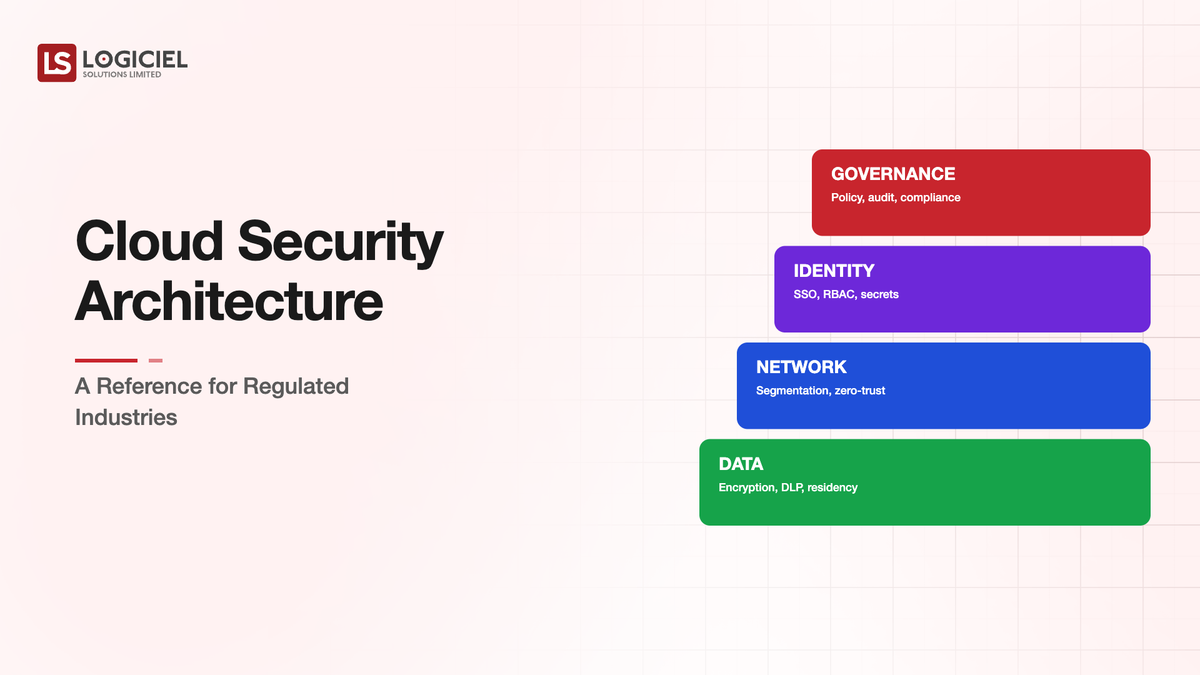
Cloud security in regulated industries rests on five controls. Each one corresponds to specific regulatory requirements but the architecture pattern is consistent across regulations.
Control 1 - Identity-centric access. All access to cloud resources flows through federated identity with multi-factor authentication. No long-lived credentials in code or configuration. No shared accounts. Just-in-time elevation for administrative access. The principle is that identity is the security boundary, not network location.
Control 2 - Encryption and key management. Data encrypted at rest and in transit by default. Customer-managed keys for sensitive data. Key rotation automation. Separation of key custody from data access. Most regulated industries require this and most enterprises implement it partially.
Control 3 - Network segmentation and zero trust. Workloads communicate only through explicitly allowed paths. Public exposure requires explicit justification. Cross-environment traffic is mediated by policy. The traditional perimeter is dead; replacement is explicit allow-listed communication patterns.
Control 4 - Automated configuration enforcement. Cloud configuration drift is detected and remediated automatically. Resources cannot be created outside policy. Standards (encryption, logging, network rules) are enforced at provisioning, not audited after.
Control 5 - Comprehensive audit logging and detection. Every API call, every data access, every configuration change logged immutably. Detection rules on the logs flag suspicious activity. Audit trails meet regulatory retention requirements. The visibility is total, not partial.
The teams that implement all five at scale operate cloud architectures that pass regulatory audits. The teams that implement two or three accumulate findings that compound over time.
What Each Regulation Demands
The five controls map to multiple regulations with consistent requirements.
SOC 2 and ISO 27001. Comprehensive coverage of access controls, encryption, network security, change management, and audit logging. Annual certification with year-round operational evidence.
HIPAA. Specific requirements for PHI handling including BAAs with cloud providers, audit trails for PHI access, encryption with sufficient key length, and minimum-necessary access principles.
PCI DSS. Specific requirements for cardholder data including network segmentation, encryption with specific algorithms, vulnerability management, and detailed logging.
EU AI Act. Documentation and audit trail requirements for high-risk AI systems, human oversight architecture, data governance documentation.
DORA. Operational resilience requirements including third-party risk management, incident reporting, and ICT testing for financial services.
State privacy laws (CCPA, CPRA, others). Data subject rights infrastructure, consent management, breach notification automation.
The same five controls, designed well, satisfy most of the regulatory requirements across these frameworks. Designing per-regulation produces fragmentation and duplication.
The Modern Implementation Pattern
Cloud security architectures in regulated industries in 2026 share consistent implementation patterns.
Cloud security posture management (CSPM). Tools like Wiz, Orca, Lacework, Prisma Cloud continuously assess cloud configuration against policy and detect drift. The category has matured significantly in 2023-2025.
Cloud workload protection (CWP). Runtime security for workloads, container security, serverless security. Often integrated with CSPM in unified platforms.
Identity and access management. Federated identity through Azure AD, Okta, or equivalent. Privileged access management (PAM) for administrative access. Zero trust network access (ZTNA) for application access.
Data loss prevention and classification. Automated discovery of sensitive data, classification, and protection. The new tooling for AI workloads adds capabilities specifically for prompts, embeddings, and AI-generated content.
Security information and event management (SIEM). Centralized log collection, detection, and response. Modern implementations integrate cloud-native logs with traditional infrastructure logs.
The stack has consolidated enough that mature implementations are recognizable across regulated industries.
The AI Security Twist
AI workloads add specific security considerations that traditional cloud security architectures did not contemplate.
Prompt injection prevention. Application-layer controls that prevent untrusted input from manipulating AI behavior. Covered in dedicated AI security frameworks but increasingly part of cloud security architecture for AI-integrated applications.
Output filtering and DLP for AI. Detecting sensitive data in AI outputs before they reach users or other systems. Specifically for healthcare, financial, and regulated industries where AI output handling is itself regulated.
Model and prompt audit trails. Which model version produced which output, with which prompt, against which retrieval. The audit infrastructure for AI is more complex than traditional application audit infrastructure.
Third-party AI dependency management. Model providers, embedding services, AI tooling. Each is a third party with security and compliance implications that fold into the existing third-party risk management framework but with AI-specific considerations.
The teams that have updated their cloud security architecture for AI workloads handle these explicitly. The teams that have not are accumulating risk in the AI portions of their stack.
What This Costs
Building cloud security architecture that meets the bar in regulated industries typically requires a dedicated security engineering team of three to eight engineers depending on scale, plus tooling investments of $200K-$1.5M annually depending on scope.
The cost of not building it is the cost of breaches at $4.9M average plus regulatory penalties for the specific industry. For regulated enterprises, the investment is rarely the bottleneck; the discipline is.
What Logiciel Does Here
Logiciel works with engineering and security leadership in regulated industries on cloud security architecture reviews, implementation roadmaps, and ongoing operational discipline. The work is typically structured around gap analysis against the five controls followed by sequenced implementation.
The Fintech AI Compliance framework covers the financial services specific requirements. The Healthcare AI Implementation framework covers healthcare specifics. The AI Security Threat Modeling framework covers the AI-specific considerations.
A 30-minute working session is enough to identify the most exposed control gap in your current architecture.
Frequently Asked Questions
How do I prioritize security investments across the five controls?
Risk-based prioritization. Map your top business risks to the five controls. Invest first where the control gap has highest potential impact. Most regulated enterprises in 2026 should prioritize automated configuration enforcement (Control 4) and detection (Control 5) because these prevent the most common breach patterns.
Should I use cloud-native security tooling or third-party platforms?
Both. Cloud-native tooling (AWS Security Hub, Azure Defender for Cloud, GCP Security Command Center) provides baseline coverage. Third-party platforms typically provide cross-cloud capability and deeper analytics. Most regulated enterprises use both in combination.
How does this work for multi-cloud architectures?
The five controls apply consistently across clouds. The implementation differs per cloud. Cross-cloud tooling (CSPM platforms, federated identity) is more important in multi-cloud than in single-cloud architectures.
What is the right cadence for security architecture review?
Annual full review. Quarterly review of high-risk areas. Continuous review through automated tooling. Regulated industries typically have audit cycles that align with this cadence.
How do I handle security for AI workloads specifically?
The five controls extend to AI workloads with AI-specific considerations layered on top. Prompt injection prevention, output filtering, AI audit trails, and AI vendor risk management all fold into the existing architecture. They are extensions, not replacements. Sources: - IBM, "Cost of a Data Breach Report 2024" - European Commission, EU AI Act timeline