The Bill That Grew Faster Than the Product
A consumer AI startup hit product-market fit in 2024 and grew revenue 8x year over year. Cloud costs grew 22x. By the time the team paused to optimize, they had burned $14M of their Series B specifically on AI infrastructure that good architecture would have cost roughly $4M to deliver.
A16Z's enterprise AI infrastructure research shows AI cloud spend growing 3x faster than other categories (Andreessen Horowitz, "The State of AI Infrastructure 2024"). The growth rate is partly justified by genuine value creation. A meaningful portion is preventable through architecture decisions made before the workload scales.
If your AI feature is gaining traction and the cloud bill is starting to alarm finance, the architecture decisions made now determine whether the next year is sustainable.
Coined Frame: The Four Cost Spikes
Four cost spikes account for most AI cloud bill growth. Each has specific architectural mitigations.
Spike 1 - Inference cost from inefficient request patterns. Calls to model providers without caching, batching, or tier routing. The default architecture (synchronous calls to the strongest model on every request) is the most expensive possible pattern. Caching, batching, and routing typically cut this spike by 50-70 percent.
Spike 2 - Embedding and vector storage cost growth. Vector databases that grow continuously without lifecycle management. Embedding generation that runs on entire datasets when only a subset is queried. Re-embedding on every minor change. These patterns produce vector infrastructure costs that scale linearly with corpus rather than with usage.
Spike 3 - GPU capacity for self-hosted or fine-tuned models. Reserved GPU capacity that runs idle most of the day. On-demand GPU pricing for workloads that could use spot. Wrong GPU class for the workload (frontier GPUs for workloads that smaller GPUs would serve).
Spike 4 - Data movement and egress for AI pipelines. Multi-region replication of training data, embedding pipelines that transfer data across clouds, egress for inference traffic going to model providers. Each looks small in isolation; aggregate is meaningful.
A team that addresses all four spikes typically reduces AI cloud spend by 40-70 percent without changing what the AI features do.
Pattern 1 - Inference Architecture That Scales
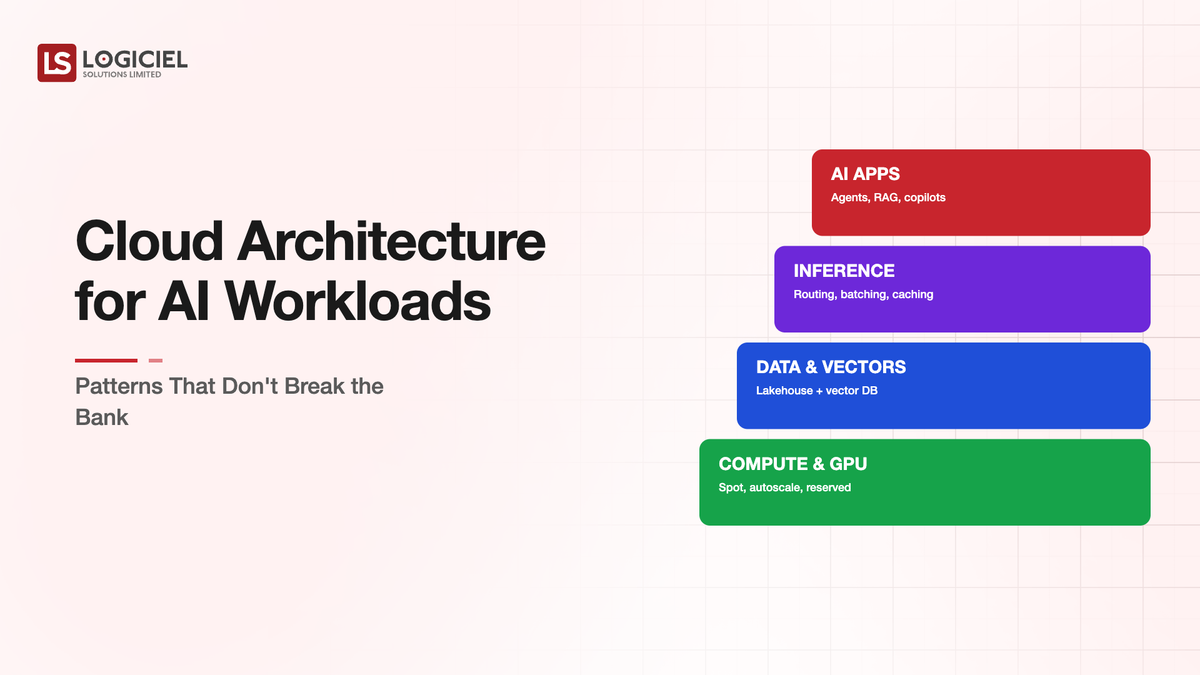
The inference architecture pattern that keeps costs reasonable has three layers.
Layer 1 - Caching. Prompt caching for repeated system prompts and document context. Response caching for identical user inputs. Embedding caching for repeated retrieval queries. Each layer of caching reduces inference cost by 20-60 percent depending on workload pattern.
Layer 2 - Routing. Tier routing sends simple requests to small fast models and complex requests to frontier models. The router itself is usually a small fast model or a simple classifier. Routing typically saves 35-55 percent of model spend at typical traffic distribution.
Layer 3 - Batching. Non-interactive workloads run through batch endpoints at roughly 50 percent of synchronous pricing. The batching infrastructure has to be designed for, but the savings are mechanical once it is in place.
The combination produces inference architecture where cost scales sub-linearly with usage rather than linearly.
Pattern 2 - Vector Storage Lifecycle
Vector databases at production scale need lifecycle management the same way data warehouses do.
Hot vectors. Recently created or frequently accessed. Stored in the production vector database with full performance characteristics.
Warm vectors. Older or less-accessed. Stored in cheaper tiers or compressed indexes.
Cold vectors. Rarely accessed but retained for completeness. Stored in object storage with rebuild-on-demand capability.
Most enterprises keep everything in hot tier because the lifecycle was never designed. The cost grows continuously. Teams that implement lifecycle management typically save 40-60 percent of vector storage cost without affecting user-facing functionality.
Pattern 3 - GPU Capacity Management
For workloads requiring self-hosted or fine-tuned models, GPU capacity management is the dominant cost lever.
Reserved versus on-demand mix. Reserved capacity for steady baseline load. On-demand for predictable spikes. Spot for batch and training workloads. The mix depends on workload pattern; typical savings from getting the mix right are 30-50 percent versus pure on-demand.
GPU class right-sizing. A100 versus H100 versus L40S versus L4 differ meaningfully in price-performance for different workloads. The cheapest GPU that meets the latency target is the right GPU. Most teams over-provision GPU class.
Multi-tenancy. Multiple models or multiple customer workloads sharing GPU capacity through fractional GPU allocation. This is operationally complex but enables much better utilization. Worth the complexity above a certain scale.
Pattern 4 - Data Movement Discipline
Data movement costs hide across many line items. The architectural patterns that control them:
Co-locate compute and data. Inference compute in the same region as the data it reads, training compute in the same region as training data. Cross-region or cross-cloud data movement at scale produces meaningful egress costs.
Pre-process before transfer. Compute summaries, embeddings, or features at source rather than transferring raw data and processing at destination.
Cache at the edge. For inference workloads with global users, cache common responses closer to users rather than calling back to model providers for every request.
These patterns typically cut data movement costs by 50-80 percent for AI workloads that have not been architected for them.
What Logiciel Does Here
Logiciel works with engineering teams building AI products at scale where the architecture decisions made now determine whether the unit economics work. The work is structured around the four cost spikes with priority on whichever spike is the largest contributor to the current bill.
The AI FinOps Framework covers the five inference cost levers in depth. The AI Cost Per Request framework covers unit economics analysis for AI features.
A 30-minute working session is enough to identify which cost spike is dominating your bill and the architectural pattern that addresses it.
Frequently Asked Questions
What is the right cloud provider for AI workloads?
All three majors (AWS, Azure, GCP) are credible. The choice usually depends on existing cloud relationship and specific AI service fit (Bedrock, Azure AI Foundry, Vertex AI). Cost differences are smaller than capability fit differences for most workloads.
Should I self-host models or use API providers?
API providers for almost all workloads below $500K monthly spend. Self-hosting requires GPU expertise, capacity management, and ongoing operational investment that rarely justifies the savings below that scale. Above it, the math becomes workload-specific.
How do I forecast AI cloud costs as I scale?
Per-request unit economics rather than aggregate budget. Cost per active user, cost per feature use, cost per workflow. Scaling reveals problems in unit economics that aggregate budgets hide.
What is the right team for AI cloud architecture?
AI engineering, cloud engineering, and FinOps representation. Pure AI engineering teams optimize for capability and miss cost. Pure cloud engineering teams optimize for cost and miss capability. The combination produces architecture that ships both.
How do I handle the unpredictability of AI workload costs?
Per-request budget ceilings, per-feature cost monitoring, and explicit fallback to cheaper alternatives when ceilings are approached. Predictability comes from the budget framework, not from the model behavior. Sources: - Andreessen Horowitz, "The State of AI Infrastructure 2024" - Flexera, "2024 State of the Cloud Report"