The Architecture Choice That Looks Simpler Than It Is
A senior engineer at a B2B SaaS company described her team's first AI feature deployment to me this way: "We picked Lambda because it was familiar. We thought serverless would make this simple. It made some things simple and made other things harder than we expected."
The team had built an AI feature that called a foundation model API and processed the response. Lambda fit the request-response shape well. The team also had a batch processing AI feature that they put on the same Lambda pattern. The batch feature hit timeout limits, ran into cold-start issues, and produced inconsistent latency. They eventually moved it to ECS.
She told me the two features illustrated something useful. Lambda is excellent for some AI inference workloads and limiting for others. The boundary is not always obvious before deployment. Knowing where it sits saves rework.
The Lambda-for-AI question gets asked a lot in 2026. Lambda's pricing, operational simplicity, and integration with the broader AWS ecosystem make it attractive. The constraints are real and worth understanding before commitment.
Why “Context” Is Becoming the New Cloud Layer
Build the quiet infrastructure behind smarter, self-learning systems. A CTO’s guide to modern data engineering.
Three Patterns Where Lambda Fits AI Workloads Well
Lambda fits AI inference workloads with specific characteristics. Three patterns describe most successful Lambda-for-AI deployments.
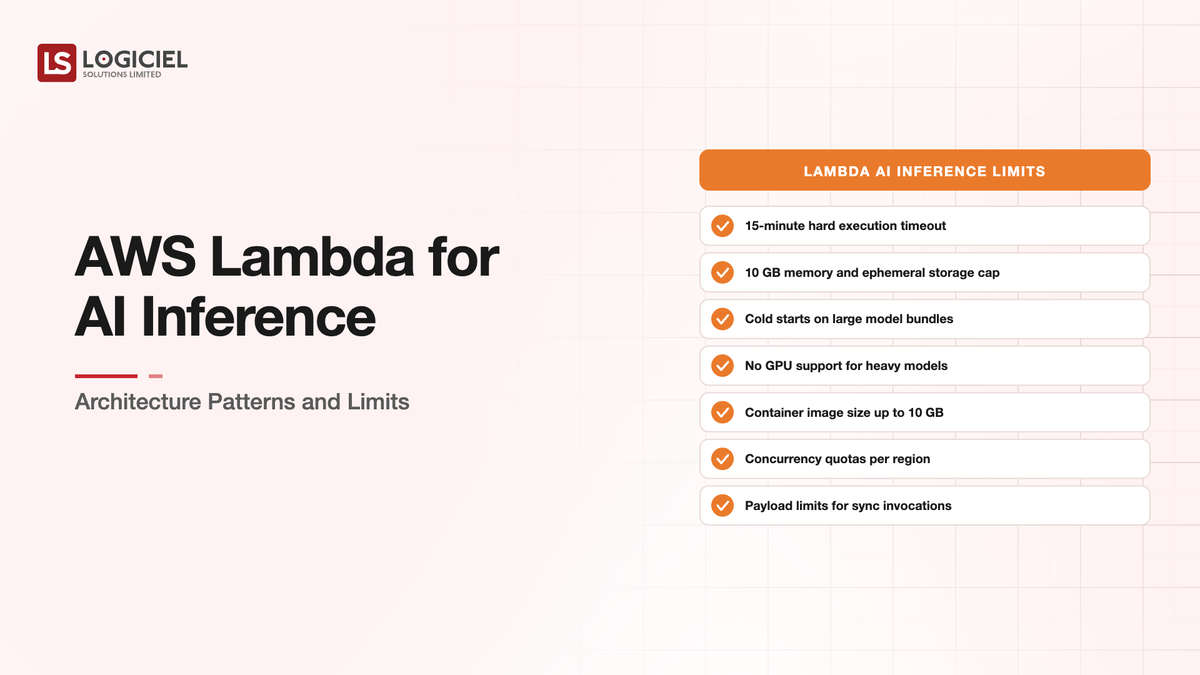
The first pattern is request-response inference with bounded latency requirements. A user request arrives. The Lambda function calls a foundation model API or a SageMaker endpoint. The response gets formatted and returned. The whole flow completes within Lambda's timeout limits (currently 15 minutes maximum, with typical AI workloads running well under one minute).
The pattern fits because Lambda's strengths align with the workload. Stateless execution. Pay-per-invocation pricing. Automatic scaling. No infrastructure to manage. The Lambda function is the integration layer between the application and the model.
The second pattern is event-driven AI processing of individual items. An object lands in S3. An event fires. The Lambda function processes the item through an AI model and stores results. Each event produces an independent processing run.
The pattern fits because Lambda integrates natively with most AWS event sources. S3, EventBridge, SQS, DynamoDB Streams all trigger Lambda directly. The architecture is simple to build and operate. The pay-per-invocation pricing matches the event-driven workload pattern.
The third pattern is API-style AI inference with light orchestration. A request hits API Gateway. Lambda processes the request, possibly making multiple model calls, and returns the result. The orchestration is straightforward (a few sequential or parallel calls) rather than complex.
The pattern fits because Lambda combined with API Gateway provides a complete API surface with low operational overhead. The AI inference adds latency that is usually within acceptable bounds for the request-response pattern.
For these three patterns, Lambda is often the right choice. The operational simplicity is real. The cost economics work. The integration is clean.
Three Patterns Where Lambda Does Not Fit AI Workloads
Lambda hits limits on AI workloads with other characteristics. Three patterns describe most cases where Lambda is the wrong choice.
The first pattern is long-running inference workloads. AI inference that consistently runs above ten or fifteen minutes does not fit Lambda's timeout constraints. Long-context model invocations on the largest models can approach these limits. Multi-step agentic workflows often exceed them.
For these workloads, container-based compute (ECS, EKS, Fargate) or step functions for orchestration fit better. The cost difference at sustained workloads sometimes favors containers anyway.
The second pattern is workloads with high consistent throughput. Lambda's pricing model favors variable workloads with significant idle time. Workloads that run continuously at high throughput sometimes cost more on Lambda than on equivalent reserved or provisioned infrastructure.
The crossover point depends on the specific workload pattern. Workloads running at sustained high utilization (above 50-60 percent) often benefit from reserved capacity on ECS or EC2. Workloads with bursty patterns benefit from Lambda's elastic pricing.
The third pattern is workloads with substantial cold-start sensitivity. Lambda functions have cold-start latency when scaling up from zero or when reaching new instance limits. For AI workloads where consistent latency matters (real-time conversational features, latency-sensitive operations), the cold-start variance affects user experience.
Provisioned concurrency on Lambda addresses cold-start but changes the cost model. Container-based alternatives that keep capacity warm often produce more consistent latency without the cost premium.
For these three patterns, alternatives to Lambda usually serve better. The Lambda choice in these cases produces friction that the team eventually addresses through migration.
The Specific Lambda Patterns That Help AI Workloads
Three specific Lambda configurations matter for AI workloads.
The first is memory allocation. Lambda allocates CPU proportional to memory. AI workloads that do work in the Lambda function (not just call out to APIs) benefit from higher memory allocation for the additional CPU. The right memory level requires testing; the default 128MB is almost always too low for non-trivial AI work.
The second is concurrency limits. Lambda has account-level and function-level concurrency limits. AI workloads at scale can hit these limits and produce throttling. The limits should be reviewed and adjusted upfront rather than discovered during traffic spikes.
The third is provisioned concurrency for latency-sensitive workloads. The feature keeps Lambda instances warm and eliminates cold-start latency for the provisioned portion. The cost is higher than pure on-demand but lower than equivalent container infrastructure for many workloads.
These configurations affect whether Lambda fits the workload well. Default Lambda settings often produce suboptimal AI inference experiences. Tuned Lambda settings produce results that compete with container alternatives.
The Integration Patterns That Work
Lambda for AI inference benefits from specific integration patterns.
API Gateway in front of Lambda provides the standard request-response interface. The combination supports authentication, throttling, and routing. Most AI inference APIs follow this pattern.
EventBridge provides the event-driven integration for batch and async AI workloads. Events flow from sources to Lambda for processing. The pattern decouples producers from consumers.
Step Functions orchestrates multi-step AI workflows where each step is a Lambda invocation. The pattern handles longer-running workflows by stringing together Lambda steps with checkpointing in between.
SQS provides queueing for asynchronous AI work with retry and dead-letter handling. The pattern fits workloads where the producer publishes work and Lambda consumes it at its own rate.
Each integration pattern handles a specific aspect of the AI workload. Most production architectures use multiple patterns in combination.
What This Costs at Production Scale
Lambda costs for AI workloads come from two components. The Lambda invocation cost itself. The AI model cost the Lambda function incurs.
The Lambda invocation cost is usually small relative to the AI model cost. For typical AI inference workloads where each Lambda call invokes a foundation model, the model cost dominates. Lambda contributes 5-15 percent of total cost for most patterns.
The exception is workloads where the Lambda function does substantial CPU work (running embedding models locally, processing model outputs, orchestrating complex flows). For these workloads, Lambda compute can become a meaningful cost line.
At scale, the per-invocation cost matters. Workloads with billions of monthly invocations see meaningful spend on Lambda alone. The migration to alternatives (container infrastructure) becomes economically interesting at this scale, though the operational simplicity sometimes still favors Lambda.
The Future Is Agent to Agent Engineering
Understand how autonomous AI agents are reshaping engineering and DevOps workflows.
What Logiciel Does Here
Logiciel works with engineering teams designing or evaluating Lambda-based AI inference architectures. The work is typically structured around workload pattern assessment and architecture decisions appropriate to the specific AI feature.
The Amazon Bedrock in Production framework covers the Bedrock integration that Lambda often connects to. The AWS App Runner vs Lambda vs Fargate framework covers the broader compute decision when Lambda does not fit.
A 30-minute working session is enough to assess whether Lambda fits your AI workload or whether alternatives serve better.
Frequently Asked Questions
Should I use Lambda for all my AI features?
Only for the patterns where Lambda fits. Different AI features have different characteristics. Some fit Lambda; others fit ECS, EKS, Fargate, or Step Functions better. The architecture should match the workload rather than the team's preference.
How do I handle Lambda cold-start for AI workloads?
Provisioned concurrency for workloads where cold-start affects user experience. The feature costs more than pure on-demand but produces consistent latency. For latency-sensitive AI workloads, the cost is usually justified.
What about Lambda layers for AI libraries?
Lambda layers fit small AI libraries. The 250MB unzipped size limit per function prevents large ML frameworks from running in Lambda directly. Container image deployment (which has a 10GB limit) handles larger dependencies for workloads that need them.
How does Lambda compare to SageMaker endpoints?
SageMaker endpoints serve specific ML model deployments with the model running on dedicated infrastructure. Lambda is general-purpose compute that can call SageMaker endpoints or other AI services. The two work together rather than competing directly.
What is the maximum reasonable inference time for Lambda?
Functionally, fifteen minutes (the timeout limit). Practically, anything above one minute on Lambda starts to feel awkward operationally. Long-running inference is usually better served by container infrastructure where operational visibility is clearer. Sources: - AWS Lambda documentation, 2024 - AWS Bedrock + Lambda integration patterns, 2024