Readiness Is a Snapshot, Not a Score
Most AI readiness frameworks produce a numerical score across many dimensions. The scores are usually too high (because readiness assessments are usually self-administered) and too aggregated (because dimensions get averaged in ways that obscure specific weaknesses). The frameworks describe readiness as a continuum. In practice, readiness is more like a snapshot of ten specific signals, each one binary in operational meaning.
McKinsey's 2024 enterprise AI study found readiness assessments correlated weakly with subsequent AI program success (McKinsey, "The state of AI in 2024"). The correlation increased substantially when assessments focused on specific operational signals rather than on general capability dimensions. The signal-based approach is more useful because it tells the organization what to fix rather than what to feel.
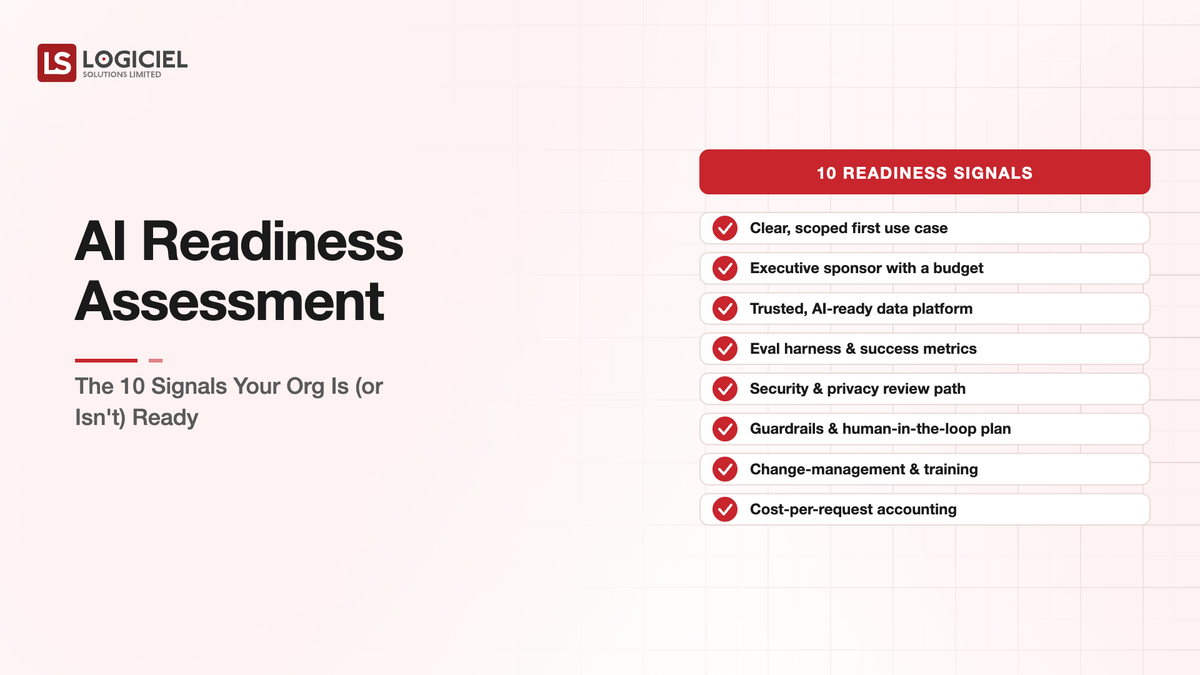
Ten signals are diagnostic enough to assess readiness without producing assessment fatigue. Each one has a recognizable yes-or-no answer if the organization is honest with itself.
The Ten Signals
The signals span data, engineering, operations, governance, and organization. They are not weighted; any signal absent is a meaningful gap.
Signal one is having a current, accurate inventory of the data the organization holds. Not what the organization wishes it had. What it actually has, where it is, and what condition it is in.
Signal two is a documented data classification and access framework. Sensitive data is identified and protected. Less sensitive data is accessible to the people who need it. The framework exists in writing and operates in practice.
Signal three is engineering capacity to operate AI systems beyond the model. The five capabilities of LLM Ops (evaluation, configuration management, observability, safety, incident response) have at least minimum staffing.
Signal four is an established practice of measuring software in production. Metrics, logs, traces, alerts. The team is comfortable operating systems they cannot see entirely in development. Without this, AI observability has nothing to extend.
Signal five is an executive who explicitly owns the AI portfolio. Not a steering committee. Not a working group. A named person whose job depends on the portfolio's success and who has the authority to allocate budget and make tradeoffs.
Signal six is a regulatory and compliance function that has begun engaging with AI specifically. Privacy, security, and risk teams understand the AI capabilities in play and have begun adapting controls. The function does not have to be mature yet; it has to be engaged.
Signal seven is a budget mechanism that funds AI work as part of normal product development rather than as a special category. Special-category AI funding usually produces disconnected initiatives. Mainstream AI funding produces capabilities that integrate with product roadmaps.
Signal eight is a culture that tolerates probabilistic systems. Engineering and product teams that have only operated deterministic systems often resist AI behavior that is fundamentally probabilistic. The cultural shift takes time. Organizations that have done some of the cultural work are more ready.
Signal nine is a track record of executing complex initiatives. Not specifically AI. Any complex initiative. Organizations that consistently deliver complex software successfully tend to deliver complex AI successfully. Organizations that consistently struggle with complex software tend to struggle with AI too.
Signal ten is a measurable baseline for the workflows AI will affect. The cost, time, quality, and volume of current operations are documented well enough that AI improvements can be measured against them. Without baselines, AI ROI is unprovable.
What Each Signal Indicates
A signal present means the organization has the foundation for AI work that depends on it. A signal absent means a specific gap that has to be addressed before or during AI work for the AI to deliver.
Signals one and two together indicate the data foundation. Without them, AI work involves either making do with bad data (producing poor results) or fixing data as part of the AI project (multiplying scope).
Signals three and four together indicate the engineering foundation. Without them, AI capabilities ship without the surrounding infrastructure that makes them sustainable.
Signal five indicates strategic accountability. Without it, AI work fragments into department-level initiatives that compete for resources and produce disconnected outcomes.
Signal six indicates regulatory readiness. Without it, AI capabilities ship with compliance gaps that emerge later and are more expensive to fix retroactively.
Signal seven indicates organizational integration. Without it, AI is a side project rather than part of how the organization operates.
Signal eight indicates cultural readiness. Without it, AI capabilities meet organizational resistance that prevents adoption regardless of technical quality.
Signal nine indicates execution capability. Without it, even good AI initiatives fail to deliver because the organization cannot execute complex work generally.
Signal ten indicates measurement readiness. Without it, AI value remains anecdotal.
Organizations with eight or more signals present are typically ready to scale AI investment. Organizations with five to seven have substantial work to do alongside AI investment. Organizations with four or fewer are probably better served addressing the foundations before scaling AI.
What This Looks Like Across Real Organizations
The McKinsey data and similar enterprise surveys suggest that most large enterprises in 2026 have six or seven of the ten signals present. The common gaps cluster around signals one (data inventory), six (regulatory engagement), and ten (baseline measurement).
The data inventory gap is the most common because data inventories require sustained discipline that most organizations have not maintained. The work to close the gap is unglamorous and high-leverage.
The regulatory engagement gap is the second most common because compliance functions have been slower to adapt to AI than engineering functions. The gap is closing as EU AI Act enforcement approaches and as compliance teams hire AI-fluent staff.
The baseline measurement gap is the third most common because measuring current operations rigorously requires effort that organizations often defer. The gap matters because without baselines, AI investments cannot demonstrate ROI defensibly.
Organizations that have explicitly worked on these three gaps tend to outperform organizations that have not, regardless of how much they have invested in AI itself.
What Logiciel Does Here
Logiciel works with organizations whose AI ambitions exceed their readiness, where the gap is producing slower progress than expected. The work is typically structured around the ten-signal assessment followed by sequenced remediation of the most consequential gaps.
The AI Accountability Framework covers the ten-item CTO readiness check that overlaps with the organizational signals. The Modern CTO Strategy framework covers the four-quadrant approach to portfolio management once readiness is in place.
A 30-minute working session is enough to assess your organization against the ten signals.
Frequently Asked Questions
What if I have most signals but lack one?
Most AI work can proceed while addressing the single gap. The gap shapes which AI initiatives are appropriate. An organization missing the data inventory signal should not start with AI initiatives that depend on complete data understanding.
How quickly can gaps be closed?
Some signals can be closed in weeks (executive accountability, budget mechanism). Some take quarters (data inventory, baseline measurement). Some take years (cultural readiness, execution capability). Realistic gap closure depends on the specific signal.
Should I postpone AI work until all signals are present?
Almost never. Waiting for full readiness defers AI value indefinitely. Better to start AI work that fits current readiness and use the AI work to drive readiness improvements. The two work in parallel.
How do I assess the signals honestly?
External assessment helps. Internal assessments are usually optimistic. A third-party diagnostic can produce honest signal evaluation that internal politics would soften.
How often should I re-run the assessment?
Annually for full assessment. Quarterly for spot-checks on the signals that are in active remediation. The signals that are stable do not require frequent re-assessment. Sources: - McKinsey, "The state of AI in 2024" - BCG, "AI at Scale 2024 Report"