A Different Kind of Software
Building an agentic AI system is not building software in the traditional sense. Traditional software has deterministic behavior, predictable failure modes, and testable contracts. Agentic systems have probabilistic behavior, novel failure modes, and contracts that need continuous evaluation.
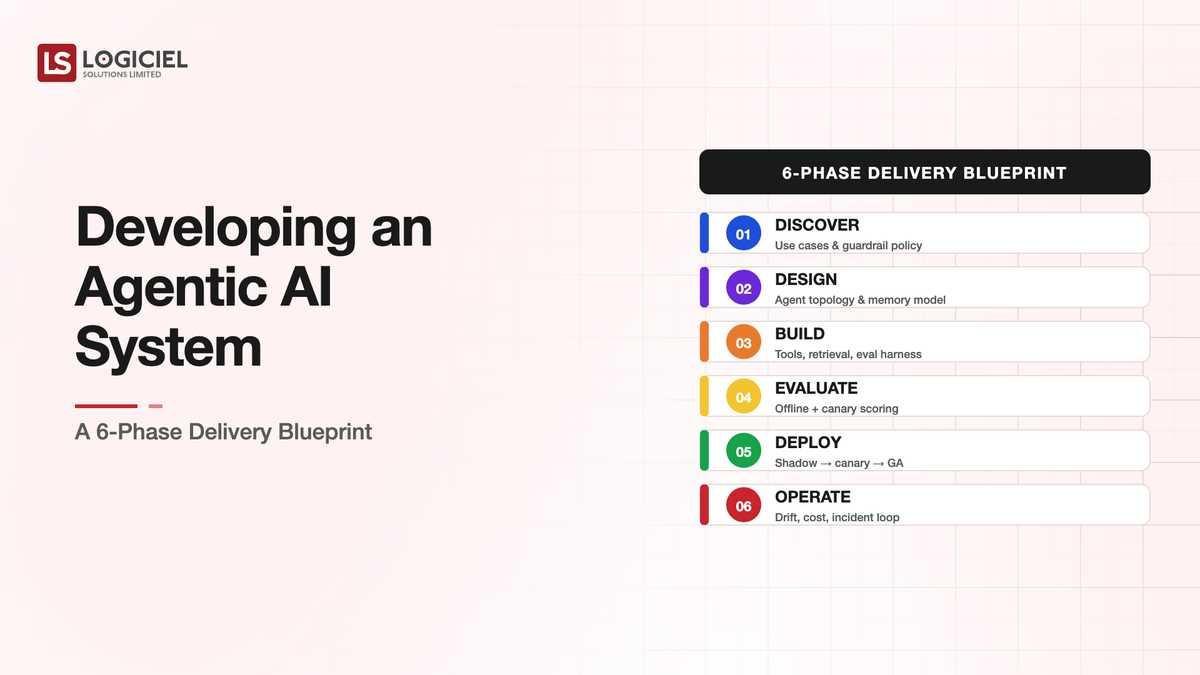
The delivery practices that produced reliable traditional software do not transfer cleanly. Teams that apply waterfall scoping to agentic work usually discover the scope was wrong. Teams that apply pure agile produce capabilities without the discipline that production-grade requires. The blueprint that works is neither pure waterfall nor pure agile. It has six phases with specific deliverables at each gate.
Most agentic systems that ship in 2026 follow recognizable variants of this blueprint, even when the teams did not start out planning to. Knowing the blueprint up front compresses the discovery time.
Phase One: Problem Anchoring (Weeks 1-2)
The first phase is anchoring the agentic system to a specific, measurable problem. Not "we want an agent for customer support." A specific problem: which customer tickets, which workflow steps, which success criteria, which failure budget. The anchoring exercise produces a deliverable that is a paragraph or two of unambiguous problem statement plus a measurable definition of success.
Skipping this phase produces systems that work in development against ambiguous criteria and fail in production against actual user expectations. The two weeks invested here save much more time later.
The gate at the end of phase one is sign-off from the business owner who will use the agent in production and from the engineering lead who will operate it. Both have to agree on the same problem statement.
Phase Two: Architecture Selection (Weeks 3-4)
The second phase selects the architecture rung (see the five-rung ladder in the related framework). This is an explicit choice rather than a default. The choice is grounded in the problem anchoring from phase one.
Deliverable from phase two is a one-page architecture document that says: which rung, why this rung and not a higher or lower one, what tools the agent needs, what the failure modes are expected to be, and what the rough cost-per-task estimate is.
The gate at the end of phase two is engineering review of the architecture choice with explicit consideration of whether a simpler architecture could solve the problem. Most failures from this phase are over-engineering rather than under-engineering.
Phase Three: Eval Infrastructure (Weeks 4-7)
The third phase builds the eval infrastructure before building the agent itself. This sequencing matters because the eval is the contract that the agent has to meet. Building the eval first prevents the trap of building an agent and then constructing evals that conveniently validate what the agent already does.
The deliverables are: an eval set of 50-200 examples covering the problem space, a rubric for what counts as a correct answer, a harness that can run the eval against any agent version, and a baseline measurement of how a stub agent (or simple prompt) performs against the eval.
The baseline matters because it tells you what improvement the agent has to deliver. If a simple prompt scores 65 percent, the agent has to do meaningfully better to justify the engineering investment.
The gate at the end of phase three is the eval running in CI with a documented baseline.
Phase Four: Agent Build (Weeks 7-13)
The fourth phase builds the agent itself. With the architecture selected and the eval defined, this phase is the most engineering-intensive but also the most contained because the success criteria are already specified.
The phase has three sub-phases. The first iteration usually scores around the baseline or slightly above. The team iterates: prompt refinement, tool integration, retrieval design, structured output schemas, validation logic. Each iteration produces a measurable change against the eval.
The deliverable at the end of phase four is an agent that meets the success criteria defined in phase one against the eval defined in phase three, plus the supporting code, prompts, and infrastructure.
The gate at the end of phase four is a documented eval result that meets the success criteria with traceable evidence (commit hash, eval run ID, sample outputs).
Phase Five: Production Hardening (Weeks 13-19)
The fifth phase hardens the agent for production. Eval success is necessary but not sufficient. Production demands operational discipline that development does not.
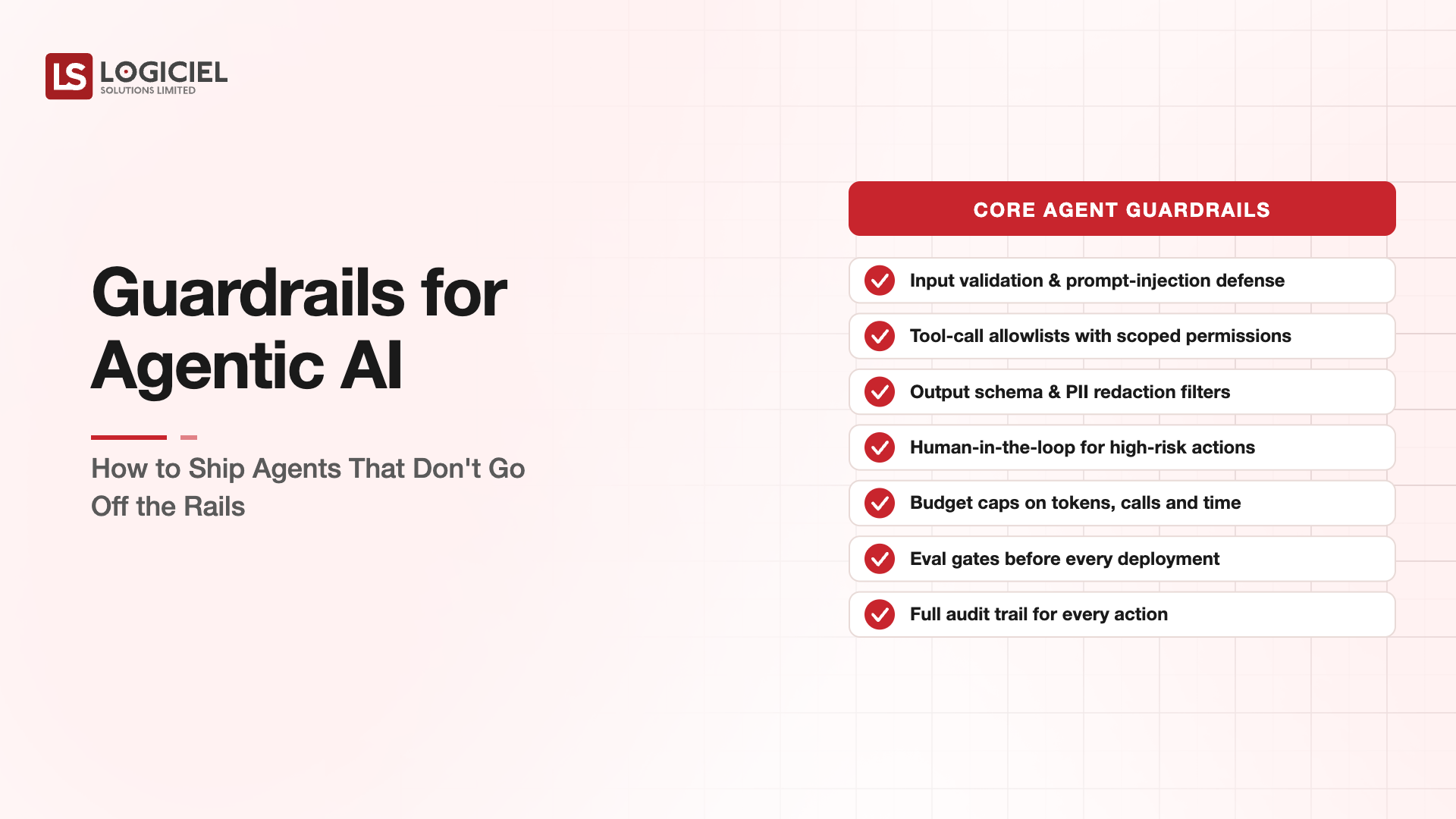
Deliverables include cost monitoring (per-task unit economics with real telemetry), failure mode handling (graceful degradation, fallback paths, error responses), security review (prompt injection mitigation, output filtering, audit logging), and operational documentation (runbook, on-call playbook, escalation paths).
This phase is the phase where most agentic projects under-invest. The agent works in development and the team is ready to launch. The hardening work feels like overhead. The teams that ship the work usually ship faster than the teams that skip it, because the skipped-work teams have to do it under incident pressure rather than under design pressure.
The gate at the end of phase five is a production readiness review with the operations team and security team.
Phase Six: Launch and Iteration (Weeks 19-24)
The sixth phase launches the agent to production with explicit early-life management. The launch is gradual: limited user cohort, increased traffic over time, explicit thresholds for rollback. Production telemetry feeds back into the eval framework. Real user interactions augment the eval set.
The deliverables are: a deployed agent serving production traffic, real-world performance metrics that match or exceed the eval results from phase four, and an iteration plan for the next 90 days.
The gate at the end of phase six is acceptance by the business owner from phase one. The success criteria from phase one are measurable against production behavior.
Why Six Phases and Not Twelve
The phase count matters because each gate is a real decision point. Too many gates produce process overhead without value. Too few gates produce blind execution that discovers problems too late.
Six phases over 16-24 weeks gives roughly one gate every three to four weeks. Each gate has unambiguous deliverables and a clear pass-fail criterion. The team knows when it is on track and when it is not.
Phased delivery for traditional software often produces too much overhead because the problems are well-understood and the gates add little. Phased delivery for agentic systems works because the problems are novel enough that the gates catch issues that pure iteration would miss.
What Logiciel Does Here
Logiciel works with engineering teams delivering their first or second production agentic system, where the blueprint matters most because the team is still developing the operational muscle. The work is typically structured around the six-phase model with priority on phases one, three, and five because these are the phases that most teams under-invest in.
The Pilot to Production Path framework covers the 12-week shortened sequence for simpler workloads. The HITL Architectures framework covers the human-in-the-loop design that often features in phases two and five.
A 30-minute working session is enough to assess where your current agentic project sits in the blueprint and what gate is the most pressing.
Frequently Asked Questions
Can I compress the timeline below 16 weeks?
Sometimes, for simpler workloads or experienced teams. Below 12 weeks is risky because the gates do not have time to function. The 16-24 week envelope is a realistic minimum for a first agentic system at production grade.
What if my team has done agentic work before?
The blueprint still applies but compresses. Experienced teams typically do phases one and two in a single week, phase three in two weeks, and complete the full blueprint in 12-16 weeks. The gates still matter; the duration shrinks.
How do I scope the eval set in phase three?
50-200 examples covering the high-frequency problem patterns, known edge cases, and a few cases that customer-facing teams flag as high-risk. Smaller than 50 produces noisy evals. Larger than 200 takes too long to run in CI.
What is the right team for the six phases?
An engineering lead, one or two senior engineers, a product owner from the business side, and access to operations and security expertise at the gates. The full-time engineering team is small. The part-time stakeholder involvement is what makes the gates function.
How does the blueprint handle multi-agent systems?
The same blueprint applies. The architecture selection phase decides multi-agent versus single-agent. The build phase handles whichever was chosen. Multi-agent systems usually take longer in phases four and five because the operational complexity is higher. Sources: - Anthropic, "Building effective agents," 2024 - DORA State of DevOps 2024